I Wanted to Be a Digital Nomad. Instead, I Built a Watch Face for Showing Up to Work
Back then, I had to get cortisone injections in my fingers.
My neck and shoulders ached too. Coding until 1 or 2 a.m. every night — my body was the first to set off the alarm.
At the time, I thought escaping the cubicle and becoming a digital nomad in a beachside café was the life I wanted.
Seven years later, the watch face I built told me something different: maybe just showing up to work, steadily, is the real answer.
I Used to Dream of Being a Digital Nomad Too
After graduating, I worked at two internet startups. I was practically employee #1 at the first one, but it shut down not long after. The second had a decent vibe and relaxed management — until policy shifts and tougher competition pushed us from 9-to-5 into 996. Deadlines tightened. "Voluntary overtime" became the norm.
In the meantime, I was building my personal project, Walbum (表盘专辑), in the hours after work. I'd get home around 10, and on a good night I'd code until 1 or 2 a.m. Most nights it was midnight, a quick wash-up, then sleep.
I'd read a lot online about indie developers and digital nomads. I envied them — picture a scenic island, a café with an ocean view, writing code on your laptop during the day, surfing at sunset, then sipping a cocktail in the sea breeze at night.
For someone stuck in a cubicle grinding out repetitive tickets, that sounded incredibly fancy.
The reason I stayed up late building Walbum was partly because I wanted to make my own product (instead of just being a programmer taking orders), and partly because I wanted that digital-nomad life too — let me at least have the fantasy.
Then I Actually Did It — for 7 Years
The first time Walbum cleared App Store review and went live. The first time a user paid for it. The first time monthly income passed my old salary. I remember all of it clearly.
I also remember the early days — limited savings, paying ¥1,700/month for Beijing social insurance out of pocket, cooking at home to save money until I got so sick of cooking that I went downstairs and ordered the same small Yoshinoya beef bowl every single day. I remember that just as clearly.
I was lucky. Walbum's revenue kept growing, and I gradually felt secure. But I also knew: if it ever stopped being useful, members would churn, and my cash vein would dry up.
Being an indie developer is basically running a tiny one-person company. You wear at least five hats: product / design / engineering / marketing / customer support. My time was more flexible, but I was tied down by far more things. I used to commute between my apartment and the office. Now I just circled my apartment.
The one upside: I could go swimming in the afternoon. The pool was empty then, sunlight slanting through the chlorine-scented water, leaving golden diagonal stripes on the blue tile floor.
I tried sleeping in. But waking at 10 a.m. meant by the time I was washed up and started working, it was almost lunch. Mornings felt unproductive. Eventually I started setting alarms. I'd still hit snooze, but my morning work hours got longer.
Once my fingers and shoulders healed, I started gaming again. But when you actually have unlimited time to game, one hour in you're already tired and don't feel like playing anymore.
After all that, I gave up my Beijing rental and moved back to Chengdu to be near my parents. I got a girlfriend, married her, had a kid. Just like that, 7 years passed — and Walbum kept shipping updates the whole time. Most weekdays I worked from home. I did visit some of those islands I used to fantasize about, but once I was there I had zero desire to work. I just wanted to swim, sit in the sun, and drink a cocktail in the evening breeze.
After 7 years of "freedom," I finally figured it out: a steady, rhythmic life is what's actually best for my work and my health.
What People Want Isn't the Nomad Life — It's a Sense of Meaning
Back to the title — why "I wanted to be a digital nomad, and instead I built a watch face for showing up to work"?
I noticed something deeper. Call it the iceberg theory.
People don't actually hate working. What they hate is doing work that feels meaningless, that drains them instead of growing them, that has no sense of value.
Take programmers: most actually love writing code. What they don't love is endless pointless meetings, or office politics with coworkers. They genuinely light up shipping a feature users rave about — and dread building slide decks for someone else's promotion. But you don't get to pick. You took the paycheck, so you do the clean work and the dirty work.
Maybe 80% of any job is dirty work. I think that's why so many people, myself included, don't enjoy going to work.
And it's the same reason so many of us fantasize about the digital-nomad life — we ignore the instability and career anxiety, and only see the "poetry and faraway places."
Put another way: freelancers have to be more disciplined than office workers, more emotionally self-regulating, with clearer goals. Otherwise the "meaninglessness" swallows you faster.
So I'm Calling It the Focus Watch Face
Whether you punch a clock or work for yourself, a steady, rhythmic life is healthier. It's better.
We should all be clearer about our work and life goals: fixed hours for working, fixed hours for resting. That stable core has been the key to a happy life across my 7 years of freelancing.
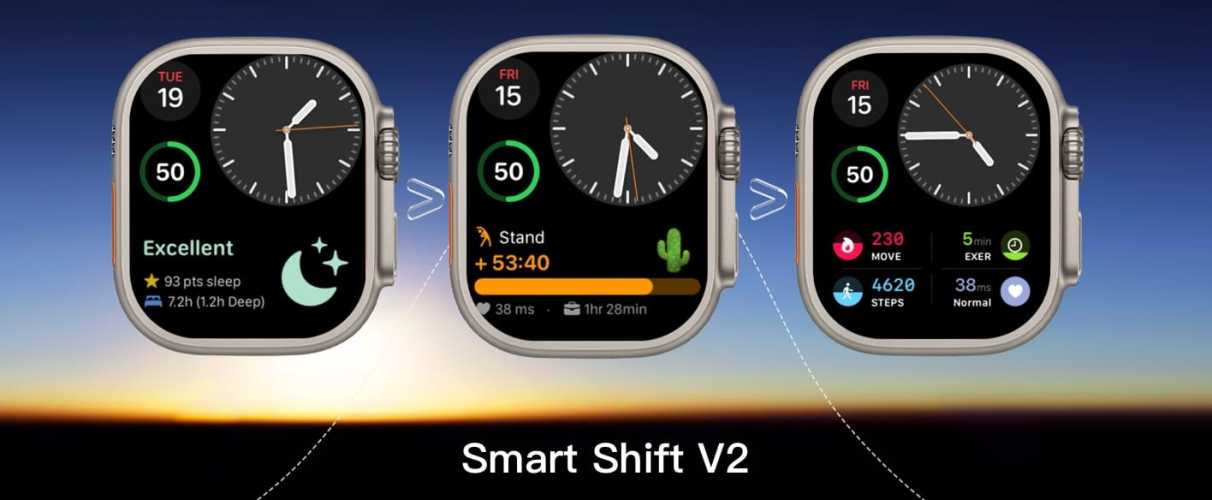
So the watch face I built does this for you automatically:
- Set your work start and end times, and during work hours it automatically tracks your focus time — a glance tells you how long you've been heads-down
- Watch face turns orange = a nudge to stand up, drink some water, look out the window
- Tap "Rest" to start a 5-minute break timer — keep focusing if you want, or let the watch take over
- Plus, real-time HRV (strongly correlated with mental stress) and a countdown to clock-out (because you also want to finish efficiently and get home to your family and your life, right?)
Writing this, I realize what we actually want isn't a "digital nomad watch face" or a "9-to-5 grinder watch face." It's a watch face that helps us show up to work honestly and live well.
Honestly, any watch face would do. So would not wearing a watch at all.
What matters is you.
(That said, as the developer selling watch faces, I went ahead and gave Smart Shift a clearer common name in Chinese — 「专注表盘」, the Focus Watch Face.)
Want to see how the Focus Watch Face works? Check out the Smart Shift Official Guide, or grab Walbum on the App Store.